
How the AI Agent Content Factory turns one brief into a reviewed article
A single blog post touches more people than it looks like. Someone picks the topic. Someone researches it. Someone works out what readers search for. Someone writes, someone edits, and someone turns the result into a LinkedIn post and a newsletter. In a small team, that's often one tired person switching between four tools and pasting the same brand guidelines into each of them.
The AI Agent Content Factory (AACF) is how we organise that work. Each job gets its own AI agent. The agents are connected, so each one's work flows into the next. And the workflow stops where a person needs to decide.
What you see
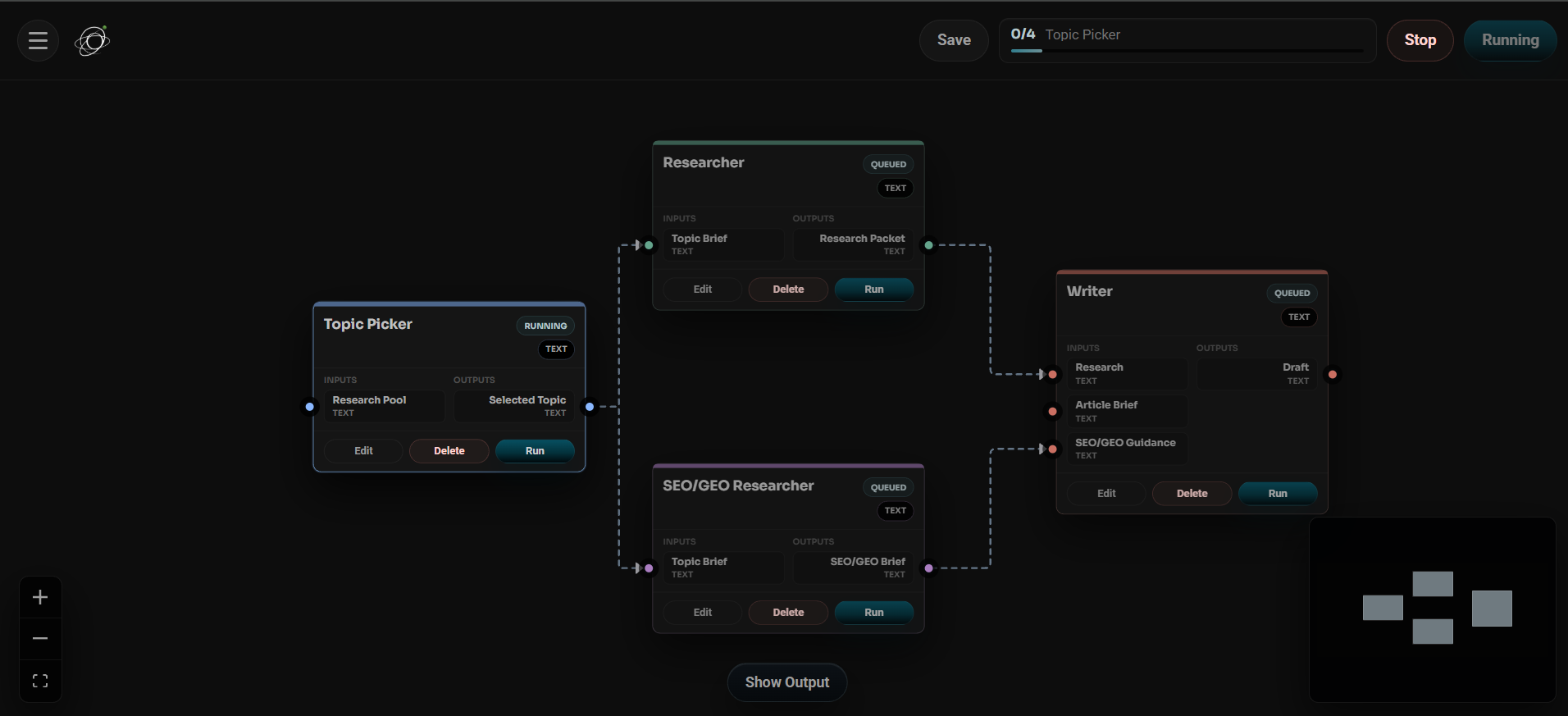
AACF is a canvas. Each box on it is an agent with one job: Researcher, Writer, Editor and so on. You drag the agents you need onto the canvas and draw lines between them. A line means "this agent's output becomes that agent's input".
That's the whole idea. The canvas shows your content process as it really is, instead of as a chain of chats nobody else can see.
One article, step by step
Here's a typical workflow for a blog post.
| Agent | What it receives | What it produces |
|---|---|---|
| Topic Picker | Your brief, or a list of topic ideas | One chosen topic, the audience and the problem it solves |
| Researcher | The chosen topic | A research brief with sources, each rated for strength |
| SEO/GEO Researcher | The chosen topic | The questions readers ask, key terms and a suggested structure |
| Writer | Both briefs | A full draft that cites only sources found in the research |
| Critic | The draft and both briefs | A fix list: what's wrong, where, and how serious |
| Editor | The draft, the fix list and both briefs | The final article, ready for a person to approve |
The two researchers work at the same time, because neither needs the other's output. Once the article is approved, more agents can pick it up: a LinkedIn Post Writer, an Instagram Post Writer, an Email Newsletter agent and an Image Creator that writes a prompt for a cover image and generates it.
What makes it different from prompting a chatbot
Your company context lives in one place. Who you are, what you offer and who you're writing for is written once and given to every agent. Nobody pastes the brand guidelines again, and every agent works from the same version.
Each agent has a narrow job. A writer that only writes, and a critic that only critiques, are easier to check and easier to improve than one assistant asked to do everything. You can open any agent and edit its instructions.
Research comes with sources. The research agents search the web and return their sources. The Writer is only allowed to cite what the research found, which makes every claim traceable.
You choose the model for each step. AACF works with models from OpenAI, DeepSeek, Kimi and Z.ai. A fast, low-cost model can sort topics while a stronger one writes. You don't have to use the same model for everything.
Your own material goes in. You can attach files to any agent: brand guidelines, product sheets, interview transcripts, past articles. Text from PDFs and Word documents is extracted and passed to the agent with its instructions.
You stay in control of the run. You can run the whole workflow or a single agent. Review points pause the run until a person approves, or sends the step back with instructions for another pass. Finished work can be exported as text, PDF or a Word document.
What it doesn't do
AACF doesn't publish anything on its own. Every workflow we set up ends with a person who reads the result, checks the sources and decides whether it goes out.
It also can't know what only your team knows: what you've seen with your own clients, what you'd never say, which claim is technically true but misleading. Agents do the research, the drafting and a strict first edit. Judgment stays with you. We've written openly about why that matters in What our AI agents get wrong most often.
Who it's for
AACF fits teams that need to publish consistently but can't staff every step: founders doing their own marketing, lean marketing teams, and businesses whose expertise is real but rarely makes it onto the page. It works best when the content follows a repeatable shape, such as blog articles, newsletters or social posts built from a longer piece.
It's less useful for one-off creative work, where the process changes every time.
See it for yourself
The AI Agent Content Factory page has an interactive demo. You add the Writer to a workflow, connect four agents in the right order and run them. It takes a minute or two, and it shows how the pieces fit better than any description.
If you'd like a workflow like this built around your own content, request access and a free audit. We'll map your current process with you and show where agents could take over the repetitive steps.